Irregular rhythms, complex passages and musical flair
Alex Vella Gregory finds a perfect balance between saxophone and piano in this concert that celebrated the Jazz Age.
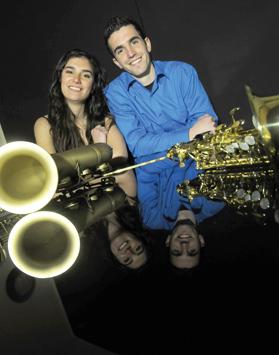 Christine Zerafa and Philip Attard.
It is not easy sustaining a solo saxophone recital, especially if you decide to limit yourself to music written in one specific decade. But this is exactly what saxophonist Philip Attard, together with pianist Christine Zerafa, offered their audience at a splendid recital supporting the Research, Innovation & Development Trust (RIDT) at Sala Isouard recently.
Despite being invented by Adolphe Sax in 1846, it was not until the 20th century that the saxophone earned its place in the pantheon of instruments. Although the reasons for this are too complex to outline here, one must point out that this instrument embodied the sound and aesthetic of the Jazz Age.
By choosing works written in the 1930s, these performers were celebrating not just the instrument but an era in itself.
Attard is one of Malta’s leading young saxophonists, of which thankfully there are quite a handful. There is much to laud in his performances. Not only is he technically polished, but he is a born showman.
It takes a remarkable pianist to keep up with such a talent as Attard, and Zerafa was more than a match
In general, he excels most in virtuosic pieces, and if there is humour to be conveyed, so much the better. However, one can detect a maturity in his sound that has been developing steadily over the last few years, resulting in a wider range of emotions and expressions.
It takes a remarkable pianist to keep up with such a talent as Attard, and Zerafa was more than a match. If I may say so, she was indeed the star of the show, not because she played any better than he did, but because her support was constant. Zerafa knew exactly when to lead, when to fade into the background and when to take over.
The programme contained a well-balanced variety of styles which really demonstrated the saxophone’s versatility. I will not review the programme in the order it was performed but rather in chronological order, as it allows for a better understanding of the repertoire.
The earliest work represented, and also the first on the programme, was the famous Glazunov Concerto for Saxophone. This one movement work represents the first major concerto for the instrument to have achieved fame. This was the work that least impressed me, not because it was technically lacking but because I find the substitution of the orchestra with the piano detrimental to this work. I have also had the pleasure of hearing Attard perform this work with the Malta Philharmonic Orchestra at the Debutantes Concert a while back, and it was a different thing altogether.
The next work (chronologically speaking), was also the final of the whole evening. This was Jacques Ibert’s Concertino da Camera. This piece was a veritable test for the artists’ communication skills. The irregular rhythms and syncopations made for some very difficult passages, all of which were surpassed with great ease and flair.
Apart from that, they also shone in the more lyrical passages, especially the second movement. Although not my favourite piece on the programme, it was the piece which best demonstrated their artistic affinities as performers.
The only moment of respite in the whole programme was Bozza’s Aria. This short piece is very much in the same vein as Rachmaninoff’s Vocalise. A beautiful, soaring melodic line rests on a simple harmonic accompaniment. The piece gave ample opportunity for Attard to show off his seemingly endless sustained phrases.
The most recent work on the programme was Paul Creston’s Sonata Op. 19. This proved to be one of those discoveries which make concert going worthwhile. It is a great work, full of jazz idioms and rhythms, that was spectacularly played by the two musicians.
The range of emotions and sounds that the both of them produced was absolutely fantastic. Although it is always unfair to laud one musician over another in this type of setup, I cannot but mention Zerafa’s superb execution of this work.
One final comment, and I do not intend this sarcastically. A big well done to the page turner who was with Zerafa all throughout, and never failed a page turn. It takes guts and stamina to page turn, and it is a great responsibility that most musicians shun. I personally would not have done it.
Both performers will be furthering their musical education abroad later this year, and I am sure that we will hear more of them in the near future.
I would also encourage readers to check out more about RIDT on www.ridt.eu. Collaboration, research and support; that is the way forward.