Classical CD reviews
Bliss: Checkmate (Complete Ballet) – Mêlée Fantasque – Royal Scottish National Orchestra – David Lloyd-Jones (Cond.) – NAXOS 8.557641 (65 mins) Sir Arthur Bliss (1891-1975) is one of Britain’s leading composers from the 20th century. Unfortunately, his...
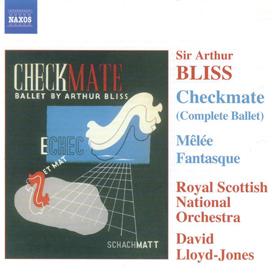
Bliss: Checkmate (Complete Ballet) – Mêlée Fantasque – Royal Scottish National Orchestra – David Lloyd-Jones (Cond.) – NAXOS 8.557641 (65 mins)
Sir Arthur Bliss (1891-1975) is one of Britain’s leading composers from the 20th century.
Unfortunately, his career spanned that of other great British names such as Vaughan Williams, Holst and, most of all, Britten. Consequently, his music is not performed all that often.
Another reason for this might be his half-American stock, something that did not endear him wholly to the puritanical clan of British music lovers. Having studied at the Royal College of Music and served with distinction in the Great War, Bliss embarked on a compositional journey that was to take him to the frontiers of modernism.
Despite his appetite for experimentation, his output includes many attractive works and a number of film scores, and these endeavours were rewarded by a knighthood in 1950 and his appointment as Master of the Queen’s Music in 1953. His formidable organisational talents as director of music at the BBC during World War II were also a factor for these royal recognitions.
Checkmate was inspired by one of Bliss’s great pastimes: chess, and the work was written in almost a year (1936-1937). Premiered in Paris in June 1937 to the choreography by the peerless Ninette de Valois, the ballet was a resounding success and, with its striking ideas and colourful effects, it has remained in the repertoire ever since. The Mêlée Fantasque dates from 1921 and the composer considered it to be his first ballet score, although at just 12 minutes it can hardly be labelled as a full ballet.
Betraying influences from Stravinsky and Diaghilev’s Ballet Russes, the piece alternates between colourful episodes and elegiac passages. It evokes the memory of one of Bliss’s most affectionate friends, Claude Lovat Fraser, himself a renowned artist and theatre designer.
Not as memorable as a Tchaikovsky or a Delibes, this is vibrant and harmonically audacious music that is crying out to be heard and is deserving more than the occasional visit. Superb performances and sound complete a fine disc of some not-so-popular English music.
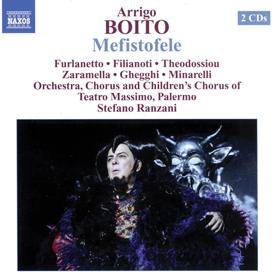
Boito: Mefistofele (Complete Opera) – Several Soloists – Orchestra, Chorus and Children’s Chorus of Teatro Massimo, Palermo – Stefano Ranzani (Cond.) – NAXOS 8.660248-49 (133 mins)
The son of a miniature painter and a Polish countess, Arrigo Boito was born in Padua in 1842. Sadly, the father deserted the family, and Arrigo and his older brother were brought up by their caring mother in Padua, Venice and Milan. Eventually, she died in 1859 and the 17-year-old boy went to live with his brother Camillo, who was seven years his senior.
Arrigo studied at the Milan Conservatory for eight years (1853-1861), but his career as a composer never really took off, partly due to his involvement in politics, which included service under Garibaldi in 1860, and his manifest literary interests on which his artistic fame survives.
Despite all this, Boito’s name has strong links to Italian 19th-century opera, to which he contributed two works: Mefistofele and Nerone. Both were to prove extremely difficult to stage, the latter remaining unfinished when the composer died in 1918 after working on it for 38 years.
Performances of Nerone are rare indeed, but Mefistofele is staged with almost frequent regularity.
First staged at La Scala in 1868, the six-hour piece was a complete fiasco, and by the end, the whole theatre was in uproar.
Boito withdrew the work immediately, but after two extensive reviews, the opera was mounted again in Venice in 1876, and this time its success was overwhelming.
Like Wagner, Boito wrote his own librettos, and so Goethe’s characters are etched out in a most uncanny and forceful way.
Boito’s score is absolutely brimming with invention and melodic fecundity, and the struggle between good and evil is depicted in music of great dramatic excitement and spectacular splendour, although moments of tender love and compassion do make their mark at appropriate moments.
Ranzani and his forces have some strong competition, as Mefistofele boasts a fair number of legendary recordings. But his brisk pacing and fastidious attention to detail give the piece the balance and poetry that are so essential for its successful impact.
Presentation and sonics are highly acceptable, but the set would have done with some more detailed information. Highly recommended, nonetheless.
These CDs were made available for review by D’Amato Record Shop of 98/99, St John Street, Valletta.