Search for new volunteers to join Dr Klown in hospital
The 1998 Hollywood film Patch Adams, starring Robin Williams. Dressed in a colourful lab coat and complete with a big, red shiny nose, Dr Gimme5 hopped into one of the outpatients’ clinics, where a young boy is nervously waiting to have a blood...
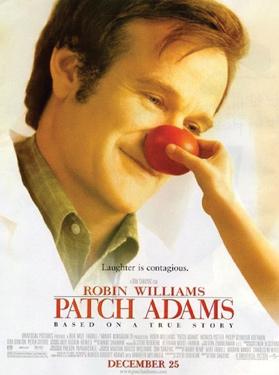 The 1998 Hollywood film Patch Adams, starring Robin Williams.
Dressed in a colourful lab coat and complete with a big, red shiny nose, Dr Gimme5 hopped into one of the outpatients’ clinics, where a young boy is nervously waiting to have a blood test.
As the clown bends down to fasten her loosened shoelaces, an avalanche of knick-knacks exploded out of her pocket – and the boy’s furrowed face instantly gave way to a beaming smile.
“We distract the children through the element of surprise,” said Corinne Wood, the person behind the antics.
“We improvise, fool about and make fun of ourselves. Hospitals are generally negative places and we help bring positivity and warmth. It’s a very fulfilling experience – it gives me a great boost which gets me through any black moments I may encounter in my life.”
The 46-year-old mother of five, who happens to be a doctor by profession, forms part of Dr Klown, an NGO which stimulates the therapeutic effect of laughter by entertaining children receiving care in the wards and outpatients’ clinics of Mater Dei Hospital.
We help bring positivity and warmth
The voluntary organisation, which was set up in 2009 by Jean Paul Fabri and Jean Pierre Busuttil, is now looking for new recruits to join its troop of clowns.
“We’re not after fully-fledged actors but people who can improvise and make others laugh,” Mr Fabri explained.
“We’ve had a phenomenal reception since we first started out – other wards have begged us to entertain their own patients as well. The biggest satisfaction to be gleaned is that, by not doing anything out of the ordinary, you make people smile and more relaxed.
“And it triggers off a whole cycle of positivity – by helping the young patients, you’re also helping their families by easing their worry. In turn, this also helps the doctors as they find it easier to carry out their work when both the patients and their families are relaxed.”
The volunteers who choose to become “clown doctors” (no medical knowledge is required) undergo both artistic and psychological training. Evening courses, theatre master classes and workshops are given by visiting foreign professionals.
The clowns themselves are given psychological support through group therapy sessions. The NGO adopts a ‘buddy system’, where clowns work in pairs, which also gives them the opportunity to perform little sketches and jokes on each other.
Each clown devises his or her own identity and back-story – Dr Wood’s clown collects high fives from children. They accompany children on their way to the operating theatre and those waiting to have blood samples taken.
Each clown is also provided with props, including stickers, balloons, face paint and greeting cards. Later this year, they will be giving out educational working books to the children, sponsored by the Good Causes Fund.
Even if you have just an hour a week to spare, you can make a difference. It gives you a lot in return too.
“It’s always a special moment when we approach a child. Their parents tell us how enthusiastically the children would have been waiting for us,” Dr Wood said.
“It’s a whole chain effect. I remember I was once in a ward with a four-year-old child at one end, and a teenager at the other. I pretended to fall down and the little one was laughing wildly. In turn, the teenager burst into fits of laughter at the child’s reaction.
“It’s an immense satisfaction to give something to these people. Even if you have just an hour a week to spare, you can make a difference. It gives you a lot in return too. It makes you discover yourself, gives you the opportunity to make a lot of friends and you also learn the working processes of a hospital.
Interested applicants are to fill in the form on www.drklown.org by not later than next Thursday.
The film which popularised clown doctors
Dr Klown is based on an idea first explored by Hunter Doherty ‘Patch’ Adams, the American doctor immortalised in the 1998 Hollywood film Patch Adams, starring Robin Williams.
Despite being poorly received by most critics, the film was a box-office success, grossing over twice its budget in the US alone and has gained a cult following. It is based on the book Gesundheit: Good Health is a Laughing Matter, penned by Adams and Maureen Mylande.
Patch Adams (Robin Williams) commits himself into a mental institution. Once there, he finds that using humour to help his fellow inmates gives him a purpose in life. He consequently aspires to become a medical doctor and, two years later, enrols at Virginia Medical University as the oldest first year student.
He questions the school’s soulless approach to medical care and clashes with the school’s Dean Walcott (Bob Gunton), who believes that doctors must treat patients as patients and not bond with them as people.
He is expelled from the medical school, although he is later reinstated due to his methods actually helping patients improve.
Adams encourages medical students to work closely with nurses, learn interviewing skills early, and argues that death should be treated with dignity and sometimes even humour.