Most audacious RAF bombing raid
Guy Gibson the 24-year-old Wing Commander was placed in command of the crews taking part in the mission. Photo: MoD/PA A retired fighter pilot has revealed the true extent of the damage the Dambusters mission caused to Nazi Germany. Clive Rowley, a...
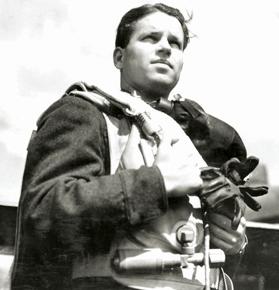 Guy Gibson the 24-year-old Wing Commander was placed in command of the crews taking part in the mission. Photo: MoD/PA
A retired fighter pilot has revealed the true extent of the damage the Dambusters mission caused to Nazi Germany.
Clive Rowley, a former commanding officer of the RAF’s prestigious Battle of Britain Memorial Flight (BBMF) turned aviation historian and author, said the military and strategic significance of destroying three dams in the industrial heartland of Germany in 1943 has only just been realised.
The 133 men who went on the mission in 19 aircraft, 56 of whom did not return, were also incredibly courageous and skilful in carrying out the daring low flights, he said.
Operation Chastise, the attack on German dams immortalised by the 1955 film starring Michael Redgrave and Richard Todd, took place 70 years ago on May 16, 1943, during World War II.
The mission was launched from RAF Scampton, near Lincoln by 617 Squadron.
A combination of bravery, ingenuity, science, technology
At the time it was hailed as an incredible success even with the loss of life, but for decades afterwards its effects were downplayed or even condemned as a waste of resources by a succession of historians.
Now, extensive research carried out by retired Squadron Leader Rowley suggests that the loss of water caused by the dams’ destruction had a far greater effect than many realised even at the time – from making firefighters powerless to put out the flames of British incendiary bombs to cutting vital German steel production due to a lack of water for cooling.
The cost of repairing the damage caused by 617 Squa3dron’s raid ran to the equivalent of £5.9 billion (€6.9 billion) in today’s money and 7,000 workers who would otherwise have been building the Atlantic Wall to prevent the D-Day landings had to be called away to fix the ruined dams.
It was an economic disaster for the Third Reich that diverted significant resources away from Germany’s war effect at a critical point during the conflict.
Four power stations were destroyed, 12 war production factories, about 100 other factories damaged, railway bridges were incapacitated, bridges knocked down, and 3,000 acres of farmland destroyed. Coal production also dropped by some 20,000 tons in the month that followed and steel production by about 180,000 tons in the month that followed.
Rowley said: “In that sense it was truly militarily important, strategically important, and I think that is more modern research that has uncovered that and hasn’t been widely recognised until now.”
The timescale in which the raid came about – the Lancaster had only been in squadron service for 17 months, and there was only 56 days from the formation of the squadron to the bombings – was nothing short of amazing, Rowley said.
He went on: “133 men went on the raid in 19 aircraft, to fly these enormous bombers with 102 foot wingspan at 100 feet, 60 feet on the attack run, in the dark.
“I’ve spent a lot of my life as a fighter pilot flying around at low level normally at 250 feet in fast jets, sometimes lower, often quite a bit faster than the Dambusters flew, but generally in daylight.
“I can state categorically that the courage, the skill, the tenacity to carry on doing what they were doing – and actually it would appear that they were enjoyingthe thrill of it – is nothing short of amazing.
“It was a combination of bravery, skill, ingenuity, science, technology, all came together in this one precision raid.”
The Dambusters crew would have been fearful, he said, but appeared fearless in order to boost morale among their fellow airmen.
They are also sure to have enjoyed the thrill of low- level flying, Rowley added.
“To them it was just a job and they just got on and did what they were asked to do and paid an enormous price for it.
“42 per cent of the men that went on the raid did not come home, and they knew that was highly likely, and yet they volunteered for the new squadron, they volunteered for the mission. They wanted to make a difference.”
Remembering and commemorating the mission, especially with such heavy losses was vital Rowley said, and even more so now to acknowledge the full extent of the effect on Nazi Germany.
He said: “It is important to recognise that it was worthwhile and that the results were worth their death, if anything ever is worth a man’s death.”
Rowley has published his findings in a new bookazine called Dambusters. It combines his detailed research with previously unpublished pictures and original artwork to provide a full account of the raid – arguably the most daring mission in the RAF’s history.