The eyes of a hawk
E.V. Borg finds graphic magic in Zhang Jianfeng’s exhibition.
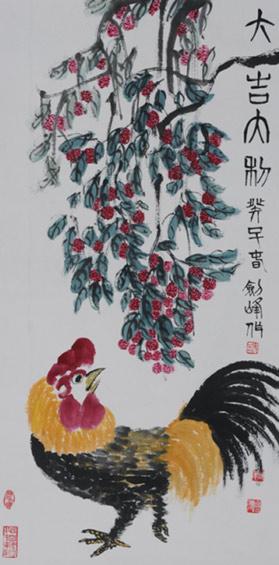
“I wish to be like sunshine, to give warmth and happiness to the people,” Zhang Jianfeng told me in his enthusiasm and passion for painting. He is a firm believer that “April showers bring May flowers”, a metaphor to his diligent and hardworking manners, in a superhuman effort to become a famous artist like Qi Baishi. He had already shown signs of this ambition when still a child.
Jianfeng is a Chinese contemporary painter in the Qing and Ming Dynasty traditional manner. He is also a great poet, writer and professor of Chinese. His art is inspired by nature and his dexterity with the brush acts like a magic wand to capture the nuances in the realistic and natural depiction of flora and fauna with the explicit intention to create a symbolic narrative language in the manner of Aesop’s fables, to educate the masses in love for his home country.
An apt quotation: “a poem in the painting and a painting in the poem” describes his work perfectly, as his expression is imbued with poetic lyricism. Jianfeng was born in a poor peasant family in Tongjiang, the Sichuan Province in the shadow of the Daba Mountains. His birth, after seven other siblings, was almost considered a calamity by his parents.
At the age of five he herded cattle, mowed and laboured in the fields as his parents did not earn enough work-points to feed the family. Once, he secretly took a kilo of edible tree fungus from his mother’s cupboard and sold it for one and a half Yuan to a soldier. With half Yuan he bought two books and read them to his heart’s content, hidden under his father’s bed.
His art is inspired by nature and his dexterity with the brush acts like a magic wand
To pay for his tuition, he picked ears of wheat after the harvest and collected eggs and sold them in a distant market. Such frugality and hardship gave him the discipline and determination to persevere and struggle towards success.
His harsh childhood was mitigated by the grandeur of the Daba Mountains and the picturesque landscape as the seasons changed. His heart melted at the song of birds, the fragrance of flowers, the sound of the flowing Yangtze, the clouds sailing past and the soft, mysterious mist. These fantastic memories stimulated his thoughts and served him well later on in life.
Jianfeng focuses in painting birds and flowers, insects and fish, water and mountain in a primordial manner to capture their essence, their numen or spirit. The chicken are fragile and soft, the mountain goats are nimble, agile and sure-footed, the eagle is regal and haughty, the fish slippery and sparkling, the lotus heavy with scent, the corncobs fat with grain, exotic birds flaunt their scarlet plumage, the bark of trees tangible and real, fruit are juicy and the bulrush swing in the breeze.
Less is more. The subject naturally fits the space on the scroll. The blank spaces rest the eye that focuses on detail. The language is simple and clear but to tackle the symbolism one needs to read between the lines. The haughty cock is the ‘Motherland’, as its shape is the map of their country. The exotic flower above it, signifying well-being for the country, is called by its nickname: the cockscomb.
The artist skillfully relates the bright scarlet cockscomb of the cockerel with the velvety flower. The eagle is heavy in flight and stops momentarily to rest. The pronunciation of eagle in Chinese is very similar to the word hero, a virtue the people of China must achieve to honour the Motherland.
Jianfeng weaves folk art with classical Chinese graphic expression in his painting to reach out to the masses as his art is socialist realism. He was foremost in the march for the revolution. In 1997 he took part in the Long March for the Motherland. He trekked the famous mountains and rivers sketching with enthusiasm and love as he advanced and finally wrote a long lyric poem, Vernal China, singing praises to Deng Xiaoping.
In 2004 he was admitted into the master class of the China Cultural Academy with top scores to further his studies on painting. He is indebted to his masters Lou Shibai and Qi Baishi. Zhang is an extraordinary artist of great genius, wise and witty. With his magic brush, his paintings look like spontaneous sketches of dexterous strokes.
He is a passionate and sincere master and a great lover of nature. He looks at life with the sharp eyes of an eagle. His observation as translated into images shows his genius, with his art being his way of seeing things.