Cape Town titbits
As Giselle McKenna’s holiday in Cape Town progressed, she learnt many interesting and quirky things about the South African coastal city. On the outskirts of Cape Town you are likely to see baboons by the side of the road. If you ask for directions and...
As Giselle McKenna’s holiday in Cape Town progressed, she learnt many interesting and quirky things about the South African coastal city.
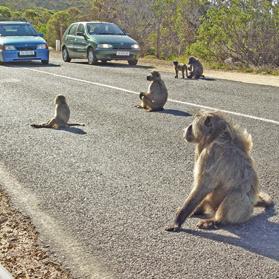 On the outskirts of Cape Town you are likely to see baboons by the side of the road.
If you ask for directions and are told to turn left at the first set of “robots”, don’t be too bewildered and think that you’ve ended up in some science-fiction film. Robots are what South Africans call traffic lights.
Apart from the name being different, they also seem to work differently, especially for pedestrians. The green man flashing doesn’t necessarily mean that no traffic is approaching; it seems to be more of a guideline that it’s generally safe to cross rather than a command to ‘cross now!’
What we would call a roundabout is colloquially referred to as a “circle” over there. For example, “keep driving straight and then go round the circle and take the first exit”. In reality, it’s an accurate description, don’t you think?
I never felt unsafe or at risk and simply acted the way I would in any major city
Sticking to the roads theme – driving in Cape Town is madness. The Capetonians claim that it’s “organised chaos”. However, their definition of ‘organised’ is very different from mine.
Parking, on the other hand, isn’t too much of an issue because their parking bays are huge. They are longer and wider than Malta’s parking spaces so manoeuvring a car into them is a doddle. Actually finding a parking space in the city is another matter altogether.
I’m not sure whether this is simply car jargon or another charming nugget of Capetonian syntax: when we went to collect our rental car we were told that the “sting” was missing. This elicited blank stares (from us) and the question “what’s a sting?” (also from us).
Apparently, it’s the car aerial. Again a wonderfully descriptive word because, once it’s explained, it’s easy to associate a bee’s sting with the car aerial depicted as the vehicle’s ‘sting’.
When driving along the roads you will see people standing not only by the roadside, but also weaving through traffic carrying all sorts of items from toilet paper to plastic flamingos! These are all for saleand they will try their best to convince you to buytheir wares.
It seemed to me that most people drove with their windows closed, in fact. Some people won’t have anything for sale, but will simply be begging for any change that you can spare.
Begging is a common sight in Cape Town and people of all ages, from children as young aseight to elderly men and women, will come up to you and ask you for money. Donating or not is a personal choice, but it’s always best to be wary and keep your personal belongings close at all times.
Due to the begging situation you will see that most retail outlets have a sign stating “right of admission reserved” and I saw a beggar being sent out of a restaurant because he was bothering patrons.
While driving in Cape Town is manic, driving outside of the city on the motorways is a mostly pleasant experience where you can drive along well-maintained roads while seeing beautiful scenery and, if you’re lucky, even wildlife such as baboons (by the roadside) and elephants (in the distance).
It is not totally pleasant because of the rather frustrating speed limits which fluctuate in a seemingly haphazard fashion. You can be driving at 80km/h and then see a sign allowing you to drive at 120 km/h and then suddenly there’s another sign indicating that you need to slow down to 90km/h, and then it’s 100km/h, then 80km/h again...
These varying speeds add significant time to your journey, unless you’re local, in which case they don’t seem to apply as most cars just sped by us without a second thought.
With all its good and bad points, ultimately Cape Town comes highly recommended and I still haven’t come across a person who didn’t enjoy it. I never felt unsafe or at risk and simply acted the way I would in any major city.
During the day, we would walk around to most places; in the evening we’d get a taxi back to the hotel so as not to be wandering unknown streets in the darkness.
We kept away from shanty towns, my bag was always kept zipped up and close to me, and money was never flashed about. Ultimately, in any major city, you need to be street smart.