All eyes on sky for heavenly spectacle
Astronomers and novice stargazers worldwide trained their eyes and telescopes on the skies yesterday for the last chance this lifetime to observe Venus track a near seven-hour path across the sun. The extraordinary event, only to be seen again in 105...
Astronomers and novice stargazers worldwide trained their eyes and telescopes on the skies yesterday for the last chance this lifetime to observe Venus track a near seven-hour path across the sun.
The extraordinary event, only to be seen again in 105 years, began shortly after 2200 GMT on Tuesday, visible first from the Pacific and north and central Americas as a small black dot trailing across the solar surface.
Australia − for which the transit of the fiery planet carries a unique historical interest as a 1769 precursor contributed to the continent’s discovery − presented one of the best vantage points.
For Europe, the Middle East and South Asia, most of the event happened overnight, and impatient planetary observers had to wait until sunrise to observe the transit’s final moments.
“After today, that’s it. Probably no one alive is going to see one of these again,” the Royal Astronomical Society’s Robert Massey said after witnessing the event from the Cotswold hills in southwest England.
“For most of us, this was the last chance. I was very lucky; we didn’t have very good weather but we actually managed to have a few holes in the clouds.”
The planet named for the Roman goddess of beauty and love only rarely moves in a direct line between the earth and the sun, and the next transit will be in 2117.
Only six transits have been observed since the telescope was invented: in 1639, 1761, 1769, 1874, 1882 and 2004 − happening in pairs eight years apart.
Cloud cover spoiled the rare opportunity for many around the world, including parts of Australia and much of Europe.“I saw it for about, maybe at most 30 seconds to a minute once, and briefly for about 10 seconds after that. It wasn’t the best view I’ve ever had,” said Mr Massey.
“We regrettably saw nothing from Paris,” lamented Claude Catala, director of the Paris Observatory.
European Space Agency (ESA) scientist Hakan Svedhem observed the passage from Svalbard, Norway − so far north that the sun doesn’t set in summer.
“It was a long night but it was very exciting and it was particularly nice to see it against the midnight sun,” he said about an hour after Venus took its leave and slid off the solar disk just before 0500 GMT.
To observers not using telescopes, the event would have appeared as a black dot about a 30th of the sun’s diameter, moving slowly over the star’s northern hemisphere.
ESA’s Venus Express is the only spacecraft orbiting the hot planet at present, and used the unique opportunity to study Venus’ atmosphere.
Factfile on the planet named after the goddess of love
Name: Dubbed after the Romans’ goddess of love. Also known as the Evening Star or Morning Star, thanks to the bright light it reflects from the sun early and late in the day. Virtually all the features on Venus are named after women of legend.
Orbit: Second planet from the sun. No moon. Orbits at a mean distance from the sun of 108.2 million kilometres. The Venusian “year” is 224 earth days, while its rotational period (the time it takes to complete one revolution on its axis) is 243 days. In other words, its year is longer than its day.
Diameter: 12,100 kilometres.
Gravity: Nine-tenths that of earth. Atmospheric pressure is 90 times that of earth’s at the surface.
Topography: No oceans, no sign of water and a surface that is apparently more arid than the driest desert on earth. Landscape comprises 70 per cent rolling uplands, 10 per cent highlands and 20 per cent lowland plains.
Few signs of asteroid impacts, mainly because space rocks burn up in the dense atmosphere before they can reach the surface.
Climate: Mean surface temperature of 457°C − hot enough to melt lead and even hotter than Mercury, the closest planet to the sun. Atmosphere is 96 per cent carbon dioxide. Venus is blanketed by thick yellowish clouds comprising sulphur and sulphuric acid droplets, driven by hurricane-force winds.
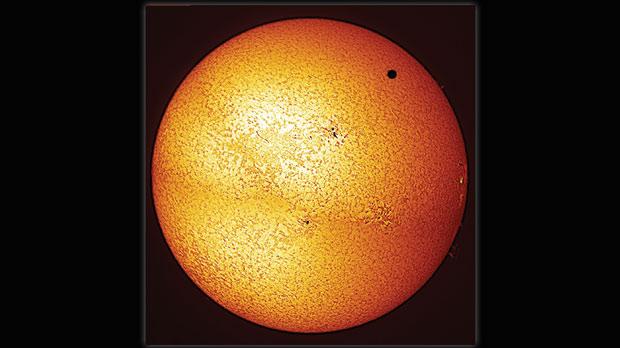 A close-up shot of the transiting Venus, seen as a big black dot over the sun, taken by Leonard Ellul-Mercer from his home in Attard yesterday morning at 6.02 a.m.
Enigmas: Venus rotates in the opposite direction to other planets: the sun rises in the West and sets in the East. One theory is that in its infancy it revolved in the same direction as earth, but was hit by a huge piece of space debris, which caused it to spin the other way. Another puzzle is why Venus is so hot. It may have been caused by a runaway greenhouse effect, something that is relevant to climate change on earth.
Venus transit: One of the rarest predictable viewing phenomena, in which Venus slides between earth and the sun, appearing through the lens as a black dot traversing the solar face.
Only six transits have ever been observed (in 1639, 1761, 1769, 1874, 1882 and 2004) because the transit is invisible without magnification. The next will not take place until 2117.