A Commissioner’s eye view
Malta’s highest representative at the Court of St James is the High Commissioner. Joanne Cocks asked the present and three former high commissioners what were their impressions on meeting the Queen. Did the Queen ever talk about her visits to...
Malta’s highest representative at the Court of St James is the High Commissioner. Joanne Cocks asked the present and three former high commissioners what were their impressions on meeting the Queen. Did the Queen ever talk about her visits to Malta?
Joseph Zammit Tabona (From 2009)
“The first time I met Her Majesty was when I was received in audience at Buckingham Palace for the presentation of my Letters of Credence. Her Majesty came across as very dedicated to performing her role of leadership and was very keen and involved in our conversation. For our first meeting, although the room was filled with protocol and formality, Her Majesty received my wife and me very warmly. The Queen’s face expressed fondness every time she made reference to her time in Malta and to the reception she received from the Maltese. My first impression of, and first meeting with, Her Majesty will always be remembered and cherished.
After presenting my credentials, I met Her Majesty in private audience. The Queen remarked on the excellent relations between the United Kingdom and Malta and requested me to renew her congratulations to President Abela who had just been appointed. After I conveyed the greetings of both the President and the Prime Minister of Malta, we dwelt on the excellent bilateral relations and discussed how they could be further strengthened, particularly in the area of trade.
Throughout the year, as Head of Mission of a country which is both in the European Union and the Commonwealth, there are various events to which I am invited. Her Majesty hosts an annual dinner at Buckingham Palace for the diplomatic corps every November. Other events include the Garden Party in July, Commonwealth Day in March and a reception for the Royal College of General Practitioners, of which Dr Clare Gerada is the Chair. Every time I go through the gates of Buckingham Palace it is a memorable experience.
Her Majesty Queen Elizabeth II reminisced on her recollections of lengthy stays as a young princess in Malta and cherishes memories of being able to drive around the entire island quite freely. From her last visit, Her Majesty realised how infrastructure has changed in Malta. Her Majesty remarked she would have loved to visit her old house in Pietà although regrettably aware of its derelict state.
During my presentation of credentials, Queen Elizabeth fondly recalled how Mabel Strickland used to send her a box of Maltese oranges to Buckingham Palace every Christmas. During this meeting, my wife Susan straightaway proposed to Her Majesty to revive this tradition at Christmas, and since then, every December I go down to Malta and bring over six dozen Maltese oranges and have them delivered to Her Majesty at Buckingham Palace around December 15. I always receive a note of thanks from Buckingham Palace upon receipt and a Christmas card personally signed by both the Queen and Prince Philip.”
Mr and Mrs Zammit Tabona have taken up Mabel Strickland’s tradition of sending Queen Elizabeth oranges for Christmas. On left is a copy of a letter which Queen Elizabeth wrote to Mabel Strickland to thank her for her gift of oranges and reminiscing of the ‘happy days’ when Prince Philip served in Malta ‘and I was able to travel about all over the island and see what was going on in every area while we lived there’. The letter appears in Victor Aquilina’s book Strickland House.
Salv J. Stellini (1991-1996)
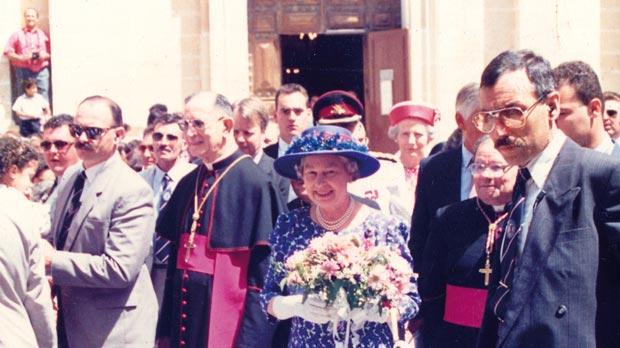 The Queen exiting the Cathedral during her visit in 1992 when Mr Stellini was highly involved.
“My initial impression of Her Majesty concerned her physical stature and in particular how petite she is; in direct contrast to the impressive image she creates through her physical presence. Every time I had the honour to meet the Queen a happy smile would emerge the moment I disclosed that I came from Malta. Obviously this was prompted by the especially fond memories of her extensive stay in Malta as a young naval wife.
The Queen mentioned how Malta had held very happy memories for her – and hoped it was doing well
To emphasise the special regard the Queen holds for Malta I would like to recall Her Majesty’s demeanour on the deck of the royal yacht Britannia as it sailed into Grand Harbour at the start of her 1992 state visit. As if by magic, the Queen seemed to have been transformed into a young girl agitated and excited, crossing from one side of the Britannia’s top deck to the other while clicking away like a photo-journalist at familiar landmarks as she pointed these out with gusto to Prince Philip.
There are two other incidents I would like to mention. The first concerns the Queen’s desire that on the way to Castille for a state luncheon her carcade should be diverted so as to pass in front of the house in Guardamangia where she and Prince Philip had resided at the time the Prince was stationed in Malta. Although this was not part of the programme, word went around and by the time the carcade arrived outside the house, a large crowd of well-wishers, practically blocking the somewhat narrow street, had gathered with many of them throwing flowers at and onto her car. The sudden sight of so many people with hardly any security around could have given rise to some apprehension, but not to the Queen, who indeed expressed pleasure at this impromptu show of affection and simply continued smiling and waving at the excited crowd.
The second incident happened as the Queen was leaving San Anton Palace where she had spent two days. Among the crowd waving and cheering, a woman was seen holding aloft a placard which read “I am Jessie’s daughter”. As it turned out, a member of the domestic staff at Guardamangia was indeed called Jessie and the Queen expressed the desire to speak with the woman with the placard. Jessie’s daughter was duly located and taken onto the Britannia where, I was subsequently told, the Queen served her tea and biscuits while showing her photos, stored in a cardboard box, of the time Jessie served on the Queen’s domestic staff.
I arrived in London to assume the duties of Malta’s High Commissioner in mid-1991. Regrettably when my time came to present my Letters of Commission, the Queen was on a state visit abroad and instead I presented my Letters to the Queen’s two sons, Prince Andrew and Prince Edward, who had been detailed to represent Her Majesty.
On the other hand, when my time came to leave London in 1996 the Foreign Office advised that I was detailed to pay a farewell call on the Queen. Given the large number of Ambassadors and High Commissioners in London, farewell calls are limited to those identified by the Queen. As opposed to the ceremony at the beginning of one’s tenure when protocol calls for very rigid formality (even photos were not allowed then), my farewell call proved to be a most pleasantly relaxed occasion: no courtiers or officials and, apart from the Queen the audience was limited to myself and Mrs Stellini. The Queen mentioned how Malta held very happy memories for her and hoped that it was doing well.
My time in London also coincided with the Maltese government’s initiative to issue a George Cross 50th anniversary commemorative medal to be awarded to service men and women who had been militarily involved in the Siege of Malta and who were still alive. There was considerable response, which however turned into an avalanche of requests when the Queen “was pleased to approve that British citizens … who are awarded the Malta George Cross 50th Anniversary Medal by the Government of Malta, may wear that medal with unrestricted permission”. The Queen’s gracious consent, printed in the London Gazette, was yet another unprecedented gesture of friendship towards Malta.
Finally, a happy word on the Queen’s character. As most people would know, Her Majesty is passionate about horse racing. Indeed the Queen is the proud owner of a number of thoroughbreds and is often seen at various racing events. Members of the diplomatic corps are not only invited to Ascot but are especially privileged at being located in the section next to the Royal enclosure. This position provides an excellent opportunity for diplomats to look at members of the royal family at quite close quarters; I remember thoroughly enjoying seeing Her Majesty at Ascot cheering on with gay abandon her horse or the one on which she might have placed a small bet!”
Richard A. Matrenza (1996-1998)
“The anticipation of meeting a reigning monarch for the first time can be slightly disconcerting. A sovereign is always royalty irrespective of one’s personal partialities towards either system of government and political institutions.
Personally, as part of my general formal education and as part of my readings in international relations I have all along developed a great respect for Queen Elizabeth II, who has followed her motto ‘I serve’ for three score years of her reign irrespective of the vicissitudes of life and fortune.
To have been burdened with the duties of high office at the tender age of 26 and to find yourself losing a much-beloved father and King to become Queen of a far-flung albeit dying Empire and also assume headship of a vast fledgling Commonwealth simultaneously with diverse cultures, needs courage and determination.
Throughout 60 years of her reign Her Majesty was and is unreservedly devoted and dedicated to her duties.
When you meet such an august person you cannot but fill yourself with admiration for this kind of monarch. On the other hand the inevitable thought cannot but present itself why such a personality who had loved and bonded deeply and had a tactile relationship with a father whom she adored, could have allowed this rapport to slip somewhat in her role as a mother.
The Queen has always had happy, relaxed and cherished memories associated with Malta both as a princess and later as a monarch. When you meet her to present your Letters of Credence to the Court of St James you are physically standing only inches away in front of her. The glint in her piercing blue eyes cannot escape you when the fond recollections are mentioned. The human in the disciplined head of state oozes out unmistakably. It may not be in the style of a cosy encounter. Protocol and diplomatic correctness do not allow discussions. However the positive remembrances are there even when cloaked in strict and rigid dimensions as demanded by protocol.
When speaking of protocol it is not out of context to recall that before the actual presentation of the letters of credence there is a proper dress rehearsal, one on one, with the Head of Protocol who belongs solely in employment to the monarch’s household. In my case, in late February 1997, it was with a most charming retired Admiral, a Scotsman who was still bringing up a young family of teenagers. When we met for an early morning meeting he apologised profusely for being minutes late, explaining the rituals of helping to prepare breakfast.
There is a special drill and procedures along which you are steered and which you are invited to remember and to follow. For example, not to leave the royal presence by giving your back, to address as Your Majesty once only in the very beginning and then refer to her as ‘M’am’ (pronounced as in ‘jam’).
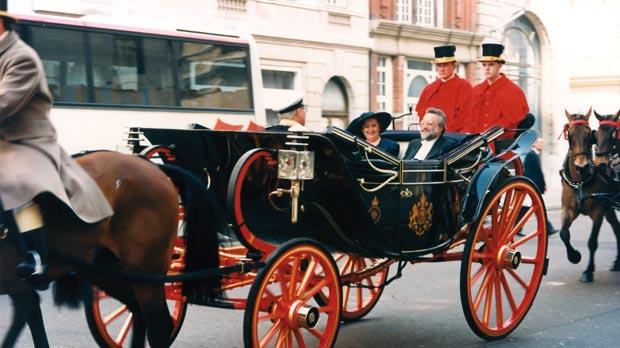
The head of protocol accompanies you and your spouse in the open carriage (it was a beautiful warm sunny day in March) going to Buckingham Palace. However, since human beings are what they are, and not withstanding the rigorous rehearsal I will never forget the embarrassment of this most charming Scotsman minutes before my audience with the Queen, six foot two of a magnificent specimen of manhood, coming up to me and stooping slightly while saying: “High Commissioner, I am afraid there is a slight change of venue. Instead of meeting in the chamber I had described to you, you will be received in another of the Palace rooms.”
Maybe there was a special reason why, after meeting Her Majesty, I was told that the Queen had graciously given me more time than usually allocated.
On the delicate question I was asked about any discussions with the Queen the plain unvarnished answer is that there are no discussions with Her Majesty. Discussions are reserved with the trained civil servants in their pinstriped suits at the Foreign Office whom you either ask to go and see or who invite you to go and meet them, offer you coffee and biscuits, discuss what there is to be discussed while a discreet secretary makes notes.”
Michael A. Refalo (2005-2008)
“In nearly 40 years of public life I had the honour and privilege to meet Queen Elizabeth on several occasions. The first time was when I was presented to Her Majesty at Malta International Airport on one of her many visits to Malta. I stood in line with Cabinet colleagues. It was simply a bow, handshake and ‘Welcome to Malta, Ma’am’ affair.
Aside from similar formal occasions in Malta and London I remember meeting and listening to Her Majesty at some length when I presented my credentials, again during a reception at Marlborough House, at an official lunch at the Auberge de Castile where as High Commissioner in office I was seated at the head table, once more in the Royal Marquee during one of the Queen’s Garden Parties and also after the Commonwealth Heads of Government Meeting (CHOGM) in Malta when the Queen presented me with framed photographs of herself and HRH the Duke of Edinburgh.
I recall Sir Anthony Figgis, at the time Marshal of the Diplomatic Corps, coming to the High Commission to take me through the Letters of Credence ceremony, the number of steps and bows one should make in Her Majesty’s presence. I remember feeling just like a schoolboy preparing to meet his headmistress on the first day of school.
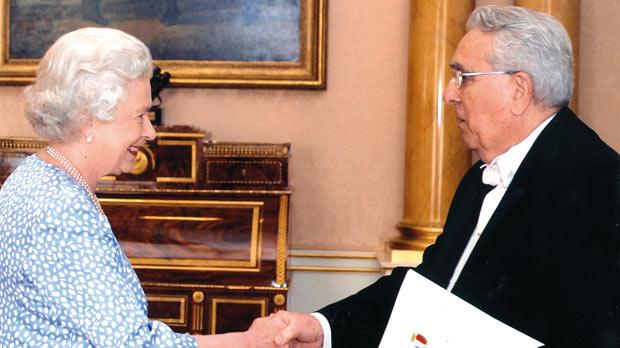
When I presented my Letters of Credence and reeled out the time-honoured formula Her Majesty handed over the documents to the Deputy Marshal and immediately put me at ease. She does not stand on ceremony and when Blanche was ushered into the room (and also went through her paces) Her Majesty inquired how we were settling in and reminisced about the happy time she had enjoyed in Malta as a young princess and later during her state visits to the island.
Through the large, high windows of the room I could see workmen putting up marquees in the gardens. Her Majesty remarked she could remember when all the workers were Irish and the foremen English. ‘Nowadays the foremen are Irish and the workers are from all over Europe and the Commonwealth!’ She struck me as being an extremely good natured lady with a keen, dry sense of humour.
During lunch at the Auberge de Castile I listened attentively and discovered Her Majesty keeps herself abreast and has a wide grasp of world affairs. At San Anton when she presented me with the CHOGM souvenirs she confided that in the morning when she opened her window which overlooked a street and looked out, she saw a woman passing by, stop, look up, wave and wish her ‘good morning’. ‘What a wonderful way to start the day!’
With more than 180 heads of mission accredited to the United Kingdom, the Queen cannot be expected to remember everybody’s nationality, let alone their names. At garden parties and the annual diplomatic reception she walks down the line of diplomats, spouses and embassy officials in the company of the Marshal and his assistants who, as they move from one delegation to another, remind Her Majesty of the country they represent. However, when the Queen approaches diplomats from Commonwealth countries who as a rule have more occasion than their colleagues to meet Her Majesty, one notices a glimmer of recognition in her eyes.
Elizabeth II is only the second British monarch to celebrate a Diamond Jubilee and has been served by no less than 12 different prime ministers from Winston Churchill to David Cameron. She is the strong, irremovable pivot around which the stability of the United Kingdom revolves.
The Queen is known to be very accessible. She introduced the “walkabout” which actually brings her physically closer to her subjects and to the peoples of countries she visits. This Diamond Jubilee should not only be a popular spectacle to mark longevity but also the achievements which Elizabeth II has accomplished during her reign.”