God, tradition and modernity in Malta today
Klabb Kotba Maltin has just launched the book Hekk Tħabbat il-Qalb Maltija, a trilogy by Oliver Friggieri. Manwel D. Schembri, a newly-graduated notary public, fifth-year law student and broadcaster, spoke to Prof. Friggieri about this threefold...
Klabb Kotba Maltin has just launched the book Hekk Tħabbat il-Qalb Maltija, a trilogy by Oliver Friggieri. Manwel D. Schembri, a newly-graduated notary public, fifth-year law student and broadcaster, spoke to Prof. Friggieri about this threefold novel.
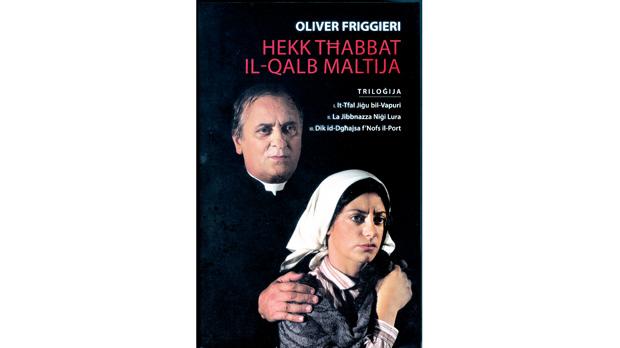
The trilogy depicts Malta of various decades ago. Can it be said to imply an analysis and a number of conclusions concerning contemporary life on the island?
An effective way to narrate the present is reconstructing the past and drawing parallels and analogies. This trilogy, comprising the three novels It-Tfal Jiġu bil-Vapuri, La Jibbnazza Niġi Lura and Dik id-Dgħajsa f’Nofs il-Port, is an effort to understand what it has meant to be Maltese and what it may mean now.
Malta has changed a lot since the early decades of the 20th century but the constants are still there.
However, much of that identity is being swept away most indiscriminately now. Change is necessary but it has to come from within.
Do you mean that contem-porary Malta is essentially different from what it was a few decades ago?
A whole tradition is being superimposed, substituted. Rather than natural development, we risk having a set of reactions, instinctive, automatic. Future generations will soon be facing the question of roots.
Your protagonist is an exemplary priest, heroic and equally simple...
The book is meant to be a tribute to whole generations of Maltese citizens who, through their priesthood and their involvement in the social and cultural life of the country, have gradually transformed a tiny stretch of land into a nation.
Should this imply that a priest is a political being?
Faith is equally personal and social, private as much as public. It is actually so in all the essen-tial aspects of life. Life is conviviality and convictions are normally shared.
How would you apply such belief to a lay state?
A lay state recognises the institutional, not essential, distinction between the state and the Church. The aims of both, at least on the social level, are identical. Call it welfare, well-being, happiness, full employment, etc.
It is always the same quest: happiness, which is also permanent. Faith is a guarantee of permanency beyond life. In any case, it is always beneficial for a state to have people who rely on religion. Respect towards religions gurantees peace.
Your novels are both political and religious. Is a distinction between both possible?
I have been trying to develop what one may call a “Catholic novel”. Identification between religious belief and political action is easily appreciated in terms of history and our modern perception has rightly acknowledged the distinction between both. But both are understood to be means to a single end: self-fulfilment.
Do you still consider Catholic faith as a central aspect of Maltese society?
It is partly a question of numbers and, in this sense, Catholics are paramountly present in both the major political parties. Both the Labour Party and the Nationalist Part were born within the Christian heritage of Malta and both are equally representative of the basic characteristics of the Maltese people.
Both the Prime Minister and the Leader of the Opposition publicly manifest their religious conviction. In doing so, they are being loyal both to themselves and to the huge thousands of people who support them. A pluralistic society recognises all faithful as equally loyal towards the same One.
For whom are these three novels mainly intended?
I have been working on them for about 12 years (1998-2010) and are meant to be read by anybody interested in delving into existential and national issues, such as what it means to be a human being, what is the function of faith and what it involves to be Maltese and Mediterranean.
You give primary importance to God in all your works. What is the relevance of God in our age?
It is a constant. God is perennially modern because life is in itself a question demanding an answer rather than an answer, self-sufficient, complete. The incompleteness of existence, the fact that life is not only lived (temporarily) but also thought, the permanent problem of suffering in all sensitive life, the urge for permanency with which all sentient beings are born and the quest for eternal survival: these and numerous analogous issues are all indicative of one fundamental point. It is that life is not simply meant to be lived; it is also meant to be studied, understood, transcended.
You frequently write about the silence of God in your works. What do you mean?
Having spent almost my whole lifetime writing, I think I have now learnt that the only “perfect” language that exists is silence.
The nearest stage is music, namely intense sound without direct meaning.
Then comes silence, the language of utter surrender, the recognition that life is superficially a fact but essentially a mystery. Echoing Albert Einstein, one can conclude that, as we know so little, that much is just enough to suggest how much more there is to be known. Einstein asserted that the only thing which interested him was “to understand the mind of God. All else are details.”
How would you define faith in short?
Faith is humility in the face of mystery. Science itself, perhaps even more than literature, illustrates this.
Your trilogy, made up of diverse novels constituting one whole narrative, seems to be stressing that life warrants meaning. Am I right in stating that this is the central theme of your works?
Yes, you are. Since the French existentialists wisely put God on the agenda of human enquiry, we cannot look ahead without recognising how solidly relevant they have been, whichever their conclusions. Their questions transcend the confines of cultural eras and are evidently actual, permanently present, always implied in art, especially in literature.
What are you expecting from the public with the publication of this voluminous trilogy?
I am once again most grateful to the public for a very positive response. I expect the novel to be noted mostly by the clergy, teachers and youths, especially those who are studying at the higher levels of education. However, I had only one specific type of reader in mind: whoever thinks so highly of life as to be sure that life is not simply a question and warrants also an answer.
That answer is called God, above proof, timeless, always modern.
I wish these novels to be read most by our youths. They deserve to share the joy and security our religious tradition has provided us with. They have a right to that joy because the world is also theirs. Let them share in the discovery of the mind of God because all else are indeed details.