Malta’s EU-Nato dispute was ‘not kept a secret’
Newspaper cuttings commenting on the dispute. The 2004 dispute over Malta’s participation in EU-Nato talks was reported in local newspapers, dismissing Labour Party claims they had been kept secret, according to reports seen by The Sunday Times. On...
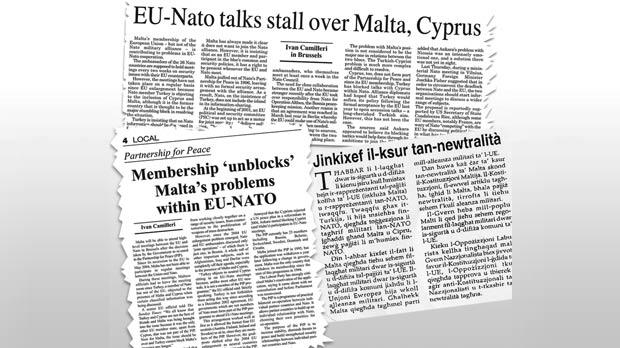 Newspaper cuttings commenting on the dispute.
The 2004 dispute over Malta’s participation in EU-Nato talks was reported in local newspapers, dismissing Labour Party claims they had been kept secret, according to reports seen by The Sunday Times.
No PQs from Labour about dispute between 2004-2008, despite newspaper reports
On Wednesday, Labour’s foreign affairs spokesman George Vella took Prime Minister Lawrence Gonzi to task for never having brought the matter to Parliament or the House’s foreign affairs committee.
Dr Gonzi was being grilled at a special meeting of the committee debating the Opposition motion censuring Malta’s EU ambassador Richard Cachia Caruana for allegedly attempting to bypass Parliament in his negotiations to solve the dispute.
Dr Vella claimed the public was kept in the dark for four years while Malta was being kicked off the EU-Nato discussion table on Turkey’s demand, due to the fact that it was no longer a member of Partnership for Peace.
But a look at newspaper reports during the four-year period shows the matter was reported and discussed in the public domain. One article, entitled ‘EU-Nato talks stall over Malta, Cyprus’, featured on the back page of The Times in April 2005.
Articles were also featured on l-Orizzont, where the Campaign for National Independence objected to the fact that Malta was seeking to be in EU-Nato discussions in the first place. Several articles were also published in The Malta Independent, as well as various foreign newspapers.
While the government never brought the matter to Parliament, the Opposition never demanded an explanation. The government says it never brought the matter to Parliament because none of its “soundings” ever came close to being formalised.
Not a single parliamentary question was asked by Labour MPs about the fact that Turkey was objecting to the presence of Malta and Cyprus.
Although Malta had joined PfP in 1995, a Labour government withdrew its participation in 1996, a decision reversed 12 years later by Dr Gonzi’s government. Today, the Opposition supports Malta’s membership in PfP.
The only question that could have been related to the EU-Nato dispute came in October 2004 by Labour MP Leo Brincat who asked whether the government had any plans torejoin PfP.
Then Foreign Affairs Minister Michael Frendo replied with a simple “no”, supporting the government’s claim that it was refusing to rejoin PfP until all other options to enter EU-Nato discussions were exhausted.
Mr Brincat had asked a similar question back in 2000 to which then Prime Minister Eddie Fenech Adami said although the government was not planning to rejoin in the near future,it still believed membership was useful and Malta’s position would have to be reconsidered in the future.
When asked about the newspaper reports, a Labour spokesman said they confirmed thatthe government never gave an explanationto Parliament.
It was “rich” to justify the government’s lackof transparency by saying there were newspaper reports about an issue that was “secretly”being discussed.
“This reminds us of the way Lawrence Gonzi increased his wage by €500 a week behind people’s backs and then saying that there were some newspaper reports about it. It smacks of the arrogance with which Lawrence Gonzi and Richard Cachia Caruana governed the country for the last years,” the spokesman said, reiterating the Opposition’s claim that Dr Gonzi and Mr Cachia Caruana circumvented Parliament to avoidthe necessary scrutiny on a matter ofnational importance.
Labour’s motion, which was based on US cables published by Wikileaks last August, alleges Mr Cachia Caruana conspired with foreign countries to find ways for Malta to take important and divisive foreign policy decisions behind Parliament’s back.
Last Wednesday, Dr Gonzi spent more than two hours explaining the timeline of events, showing that all government officials acted in the national interest for Malta to rejoin thenegotiation table, while at all stages refusing to join PfP.
He said all officials, including Mr Cachia Caruana, were working on the government’s instructions, and the “innovative” decision to state that some of Malta’s PfP agreements remained in force (to gain access) was approved by Cabinet.
Although the Wikileaks cables suggest the government made this proposal to avoid a divisive vote in Parliament, the government insists it did so not because it feared losing a vote, but because it did not want to raise a contentious issue when consensus on EU membership was finally being reached.
Parliament’s foreign affairs committee will reconvene tomorrow where Dr Gonzi is expected to be questioned further.