Relax and do it
Do meditation and yoga put our health in the right pose?
Michael Cuffaro
Sahaja yoga
What first inspired you to try yoga and what instruction did you receive?
The benefits are first of all of a spiritual nature – as a consequence, our mental, emotional and physical states also improve.
I have always been a seeker, looking for answers to difficult questions through various means, including religion, music and spirituality. What is the spirit? Why do people act the way they do? Where do diseases come from? Is there a way to be completely in silence and at peace?
I never had any satisfying answers until I found Sahaja yoga – this gave me a very clear picture which helped me answer most of these questions in a satisfying and fulfilling way.
I started practising Sahaja yoga in 2009, in Italy, where I attended free classes and seminars that were offered in my area. Now, even though I do not possess any sort of professional qualification, I have come to Malta to share what I know with whoever would like to listen, free of charge, in the same way it was shared with me.
What are the main elements of Sahaja yoga?
Sahaja is Sanskrit for ‘spontaneous’ or ‘born with’, while yoga means ‘union’. This simply means that the entire set of tools that we need to achieve this yoga (union) is already built in all human beings – we simply lack the knowledge of it.
The main element of Sahaja yoga is the awakening of a feminine, motherly energy named Kundalini, which lays dormant in the sacrum bone. Once this energy is awakened through a very simple meditation, it rises through the spinal cord, crossing the seven energy centres called chakras, and settles on the top of our heads, the fontanel bone and seventh chakra, giving us yoga, this union.
We are able to feel this whole process taking place in our body and to experience the Kundalini, which manifests itself as a cool, soothing breeze on our head and hands. This process is called self-realisation – in Sahaja yoga, we help people achieve this state on their very first session, as it is the first step towards a whole new world of knowledge and understanding of ourselves and of others.
How do yoga variations differ from each other?
There are thousands of yoga variations, originating especially in India. Self-realisation, or the awakening of the Kundalini energy, is the ultimate goal of every variation. This was once a very difficult state to obtain – therefore certain people would adopt techniques in order to first purify their body and still their mind through positions, physical exercises and breathing techniques, in order to achieve self-realisation after a lifetime. Even then, this wasn’t always obtained.
In Sahaja yoga, we allow people to experience self-realisation first, and then proceed with cleansing and purifying techniques. It’s like having a dark room filled with boxes we need to sort out – it is much easier and faster to switch the light on and afterwards get to work than to try and sort it out in the dark.
What are the main differences between exercise and meditation based yoga?
Physical yoga is beneficial as an exercise, for posture, stress release, body control and self-discipline. Meditation permits us to achieve a higher awareness, not only of ourselves, but also of humanity as a whole and the universe itself. True yoga is achieved with both worlds – Sahaja yoga encompasses a set of techniques both physical and spiritual to achieve high levels of joy and bliss.
What are the main health benefits of yoga?
There have been countless studies showing how conditions such as asthma and high or low blood pressure get immediately better once one starts meditating correctly. The posture gets corrected, chronic headaches slowly disappear, and digestive problems fade away. Meditations, while done collectively, are effectively custom tailored for every person. Over time, and with daily sessions – alone or in group – our general health starts improving a lot, and we may also leave behind us certain diseases and bad habits.
Is yoga just physical or does it also have mental and spiritual benefits?
Once this Kundalini rises, the first thing that happens is that our thoughts start disappearing – there is a pause between one thought and the next, which grows more and more in meditation, up to a point where our mind is completely silent. The latter state is called ‘thoughtless awareness’. At this point, we start really enjoying the state of meditation – we completely detach from ourselves and become like a spectator, watching the movie that is our life on a TV screen. We are not involved anymore with problems and therefore are completely free of stress and worry. Our attention gets better, we are completely at peace inside, anxiety and preoccupations vanish, and we start becoming fully aware of the truth – that we are the spirit. The benefits are first of all of a spiritual nature – as a consequence, our mental, emotional and physical states also improve.
How does yoga contribute to detoxing?
All human beings are equipped with a subtle body, which is made of energy centres (chakras) and energy channels (nadis). On an energetic level, these centres and channels control qualities such as innocence, peace, attention, satisfaction, pure love, diplomacy, and awareness. On the physical level, these centres and channels have complete control on the parts of the nervous system responsible for our organs and tissues. Should these chakras and nadis be in a state of energetic imbalance, our physical and emotional states are directly affected. In worse cases, the chakras are in such a bad state that, as a consequence, the organs start malfunctioning and diseases start.
Following self-realisation, the Kundalini itself rises and slowly restores complete energetic balance to our chakras and nadis, releasing bad energies in the form of warm air coming from our head, hands and feet. This is a very simple process that can be achieved by meditating five to 10 minutes twice a day.
Can one practise yoga on their own or is it more beneficial to participate in a yoga class?
Sahaja yoga can be practised alone, and by anyone, even after the first class. However, there is a big difference between meditating alone and meditating with a friend or in general with more people – the effects are more powerful in a group, and it is easier to enjoy each other’s company and share knowledge this way.
Can one practise yoga at any age?
Sahaja yoga is for everyone and every age. Not only that, but classes are free of charge and everybody is welcome.
What, in your opinion, are the main causes of stress and how does yoga address them?
In the western world, we tend to put a lot of pressure on ourselves, in the form of work-related deadlines, loans to pay, and chores to do. Some people tend to run around all day and most of the night and only sleep for a few hours. Moreover, it’s a mental kind of labour, rather than physical, which makes it even worse.
This constant thinking and doing, as well as the sense of competitiveness, leads to an imbalance in our subtle systems. Daily meditation gives us a chance, for five minutes, to completely release all tensions. It gives us balance and restores the good energy within us. It’s the best gift we can give ourselves.
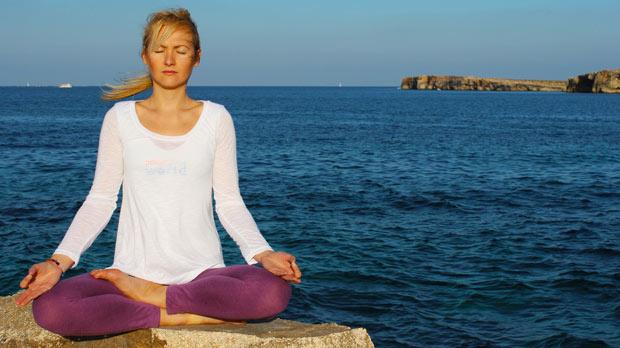
Sveta Abela
Power Yoga World
What first inspired you to try yoga and what instruction did you receive?
By gently stretching muscles and joints as well as massaging the various organs, yoga ensures optimum blood supply to various parts of the body.
My mother took me to my first yoga class when we used to live in Siberia, Russia. She had been practising yoga for a long time and always wanted me to try a lesson but there were no classes for kids and I was more into ballet. I was introduced to Hatha yoga, the traditional style of yoga which includes disciplines, postures (asana), purification procedures (shatkriya), gestures (mudra), breathing (pranayama), and meditation.
What are the main elements of Ashtanga yoga?
Ashtanga yoga is the yoga of Patanjali, the compiler of the Yoga Sutras – a very important script for yoga followers written 2,500 years ago. It is composed of eight limbs: yama and niyama, which are ethical observations; asana or physical postures; pranayama, which is a breath control; pratyahara, which is sense withdrawal; dharana, which is concentration; dhyana, which is meditation; and samadhi, which is a high state of concentration. The eight limbs are more precisely viewed as eight levels of progress, each level providing its own benefits while laying the foundation for the higher levels.
How do yoga variations differ from each other?
Hatha yoga is an umbrella term for yoga that uses physical practices to achieve yoga goals. Although any form of physical yoga is classified as Hatha yoga, if you attend a Hatha yoga class, it probably means a gentle form of yoga. If you want an aerobic workout for a toned, lean body, Ashtanga Vinyasa yoga or Power yoga could be the style for you. It is a dynamic form of yoga and benefits those seeking strength, flexibility, a clear mind, and an energy boost.
On the other hand, Iyengar yoga takes a very precise view of yoga postures. In an Iyengar yoga class, for example, you may hear the instructor talk about detailed instructions on placement of the smallest toe. There are many other styles of yoga and each style emphasises different aspects of yoga.
What are the main differences between exercise and meditation based yoga?
Some yoga lessons are based on physical postures, which are designed to improve alignment of the entire body so one can sit longer in a lotus pose. Other yoga lessons are based on breathing techniques designed to calm the mind and prepare for meditation.
What are the main health benefits of yoga?
Yoga improves flexibility – it acts upon the various joints of the body including those joints that are never really on the radar screen let alone exercised.
Yoga increases lubrication of the joints, ligaments and tendons – likewise, well-researched yoga positions exercise the different tendons and ligaments of the body. Surprisingly it has been found that the body which may have been quite rigid starts experiencing a remarkable flexibility in even those parts which have not been consciously work upon. It is here that the remarkable research behind yoga positions proves its mettle. Seemingly unrelated non-strenuous yoga positions act upon certain parts of the body in an interrelated manner. When done together, they work in harmony to create a situation where flexibility is attained relatively easily.
Yoga is perhaps the only form of activity which massages all the internal glands and organs of the body in a thorough manner, including those – such as the prostate – that hardly get externally stimulated during our entire lifetime. Yoga acts in a wholesome manner on the various body parts. This stimulation of the organs in turn benefits us by keeping away disease and providing a forewarning at the first possible instance of a likely onset of disease or disorder.
By gently stretching muscles and joints as well as massaging the various organs, yoga ensures optimum blood supply to various parts of the body. This helps in flushing out of toxins while providing nourishment, in turn leading to benefits such as delayed ageing, energy and a remarkable zest for life.
Yoga also encourages excellent muscle toning – muscles that have become flaccid and weak are stimulated repeatedly to shed excess flab and flaccidity.
Is yoga just physical or does it also have mental and spiritual benefits?
Yoga is a state of mind. Achieving the goal of stilling the mind is a tall order, so practices have been developed that allow you to move towards this state from a physical viewpoint. Quieting the mind is a rather intangible goal. In contrast, the progress made on accomplishing a yoga posture can be evaluated by alignment, length of stretch, and the length of time it can be held. It’s much easier for you to relate to something tangible – the body – and then move on to something intangible – the stillness of the mind. During yoga practice, you begin somewhere known and, using your body and breath, you move toward an unknown. As you open your body and mind with yoga postures and breathing, you become receptive to the profound experience of inner stillness.
Can one practise yoga on their own or is it more beneficial to participate in a yoga class?
It is best to start learning yoga under the guidance of a qualified and experienced yoga instructor. But if one doesn’t have the possibility to practise with a teacher, yoga can be practised at home. There are many different books on yoga as well as videos, TV channels and online clips. Be very careful and gentle in your practice – start with simple poses and learn just a few postures first and then progress gradually. Always go at your own pace and stop if something does not feel right or safe.
Can one practise yoga at any age?
Yoga can be practiced at any age but everyone has to find a suitable class according to their age group and ability.
What, in your opinion, are the main causes of stress and how does yoga address them?
We are all caught up in a world where stress is epidemic and affects us all. The conflicts and pressures of a fast-paced life can lead to stress, while insecurity and dissatisfaction arising from unresolved problems or unfulfilled needs cause frustration. Frustration can be due to external events – approaching examinations or an interview, arguments with your boss, mounting debts or being late for work.
Frustration can also be due to internal reasons, including unrealistic expectations and unwillingness to change. These are the biggest causes of stress that give rise to a feeling of frustration. Conflicts also cause stress when there are two or more incompatible needs or demands. Pressures of living cause you plenty of stress. These are the demands that life makes on you on daily basis.
Medical research has confirmed the role of stress in premature ageing, as well as its complicity in many common health problems such as hypertension, diabetes, asthma, sexual dysfunctions, insomnia, peptic ulcer, depression, neurosis, digestive disturbances, and even cancer. On top of that, stress weakens the immune system and makes you vulnerable to infection and other medical conditions.
Yet relief from modern medicine can be often less than fulfilling. Indeed, many who seek the advice of a doctor are simply told that they are tense, which is what they already knew. But apart from medication in the most extreme cases, there may be little to offer in terms of remedy except for advice to find time to relax. What, then, is one to do? Many have found yoga to be the answer.