Talking about extremes
He may be foolish or brave, but director Pierre Ellul tells Paula Fleri-Soler he hopes his documentary on the indomitable Dom Mintoff will contribute to a more mature national discussion on the turbulent post-war years. Towards the end of Dear Dom, a...
He may be foolish or brave, but director Pierre Ellul tells Paula Fleri-Soler he hopes his documentary on the indomitable Dom Mintoff will contribute to a more mature national discussion on the turbulent post-war years.
Towards the end of Dear Dom, a caption appears stating that Mintoff remains the most controversial figure in Malta’s political history. Despite that, does Ellul believe the documentary is a fair portrayal?
Many people were happy to say great things about Mintoff, but hardly anyone would talk about the bad on camera
“I think it is,” he replies confidently. “I did take a position because as a film-maker you have to; you can’t sit on the fence. Yet I believe that it is ultimately a fair portrayal of the man and the events.”
Given that Mintoff was in politics for a long while, deciding what to include and exclude must have been quite a headache. Ellul explains that his starting point was the level of emotion that Mintoff triggers in people. Warming to the subject he explains why he interviewed the people he did.
“I basically looked at Malta, an island nation, and looked at a microcosm of that nation, represented by a village. In any village you have the villagers, and among the prominent people of that village you will find a priest, a politician and a doctor.”
He elaborates by explaining his choices of former Labour minister Lino Spiteri, Can. Joe Abela and former Nationalist MP Joe Psaila Savona.
Spiteri was not just a colleague of Mintoff’s; he was personally impacted by the Church’s interdict of the Labour Party in the 1960s forcing him to get married in the sacristy.
Being the only priest from a family of dockyard workers, Can. Abela was hugely conflicted during same Interdict while Dr Psaila Savona talks about his personal experience of the doctor’s strike and the terrible things he later endured as a Nationalist Party candidate.
“They all have their personal stories to tell,” Ellul muses.
The National Bank saga features prominently. Ellul explains that he saw this particular event as the turning point in what he describes as “the rise and fall of Mintoff”. He says he is fascinated by Mintoff in the 1950s and 1960s – especially his fight for civil liberties and the clash with the Church.
“When he was back in power in the 1970s,” Ellul continues enthusiastically, “Mintoff starts with a bang. He immediately negotiates the defence agreement with the British; from £5 million he ups it to £14 million a year; that takes us to 1972.
“Then in 1973 he shifts his attention to the local scene and sets his sights on the bank. It is an intriguing story. This is where the shift starts happening.”
Some may question why certain ‘obvious’ events were glossed over – the Raymond Caruana murder, for example, or the infamous Tal-Barrani mass meeting. “I don’t think they are glossed over. I just didn’t want to use images that have been over-exposed throughout the years”.
The former incidents together with the burning of The Times building, the ransacking of the Curia and the law courts are starkly illustrated by animated images. Was this simply an artistic decision or was it lack of access to footage? “I didn’t manage to find any archive footage of most of these events,” he says.
I commend him on the effectiveness of the animation, commenting that the sound of marching boots is pretty powerful. “That’s why I juxtaposed it with child’s music,” he interrupts.
“I wanted to depict the stark contrast of the violence with the innocence of an independent nation which is still very young. The choice of music there is deliberate. We are talking about extremes. We are talking about a character who is divisive. In people’s eyes he sits on the extremes – there’s no in-between.”
Given these extremes, was it easy to get people to talk about Mintoff? “I started carrying out vox pops in different towns,” he says.
“Many people were happy to say great things about Mintoff, but hardly anyone would talk about the bad on camera. These people were willing to talk to me face-to-face, but the moment I pulled out a camera it was ‘no, absolutely not’. So it was a matter of finding people who were willing to stick their neck out.”
Dear Dom addresses Mintoff the politician, and there is little about Mintoff the man. Ellul says he initially wanted to get Mintoff on camera, and produce a one-on-one piece, but Mintoff’s failing health put paid to that idea.
“I believe that if we had to look into his personal life, it would give us much better insight into how he operated,” he says, pointing out that in the film we do get a little glimpse of the man when Carlo (one of Mintoff’s aides) reminisces about a game of boċċi during which Mintoff kept on playing through the night until he got a draw.
“Mintoff was a fighter. I think he operated from that place as a person, in whatever he did.”
How did the idea of tackling the documentary as a letter to Mintoff come about? Ellul explains that while carrying out research in the UK national archives, he came across many letters which were sent to him by the British addressing him as “Dear Dom” not “Dear Prime Minister”.
“Also,” he says with a smile, “when in 2006 I phoned Mintoff with my original idea, he told me ‘iktibli’ (‘write to me’). So I did. In a way I thought that it was an interesting way to tie it all together. As a letter it kind of worked.”
I tell him that I feel audiences need to be well-versed with the events of the time to truly appreciate the documentary. Does he think this will hinder its chances of it finding a non-Maltese audience?
Ellul agrees, stating that in its inception it was aimed squarely at Maltese audiences. He hopes, however, to re-cut it for a foreign audience; removing certain things and adding further background.
What sort of reaction is he hoping to get? “I hope that people try to step out of their comfort zone and examine the events with fresh eyes,” he answers thoughtfully.
“What I tried to do here is take the viewer on a journey through Malta’s modern history presenting facts, experiences and events that happened.
“Like it or not, Mintoff started Air Malta and other enterprises from nothing.
“Like it or not, the violence in the 1980s happened under his watch. One cannot pick and choose what happened. Hopefully some people will watch it and break away from their polarised stance.”
He pauses, and then adds: “I’m being a bit of an idealist here, but I hope that the film makes people acknowledge what other people went through so that they don’t just look at things from their point of view alone.”
Finally, how does he himself feel about it? “I’m happy with the end product. I mean, it can always be improved. I’m highly critical of what I do and I question things a lot. But I think it’s a good first feature.
“I’ve said before, Mintoff is a Pandora’s Box. Once you open him up you can go on forever. By no means is this a comprehensive or definitive take. It is simply my take and it is impossible to go into the detail of everything in just 67 minutes.
“Someone told me I am either very foolish or very brave for tackling this subject. I don’t know which it is really... maybe I’m both. I really feel that in 2012 we should be able to discuss these events a bit more maturely.
“At the end of the day, this is our story. My film does not seek to dictate a view on Mintoff. I leave that up to the viewers to decide for themselves, hopefully from a slightly more informed position.”
The man who tackled Mintoff
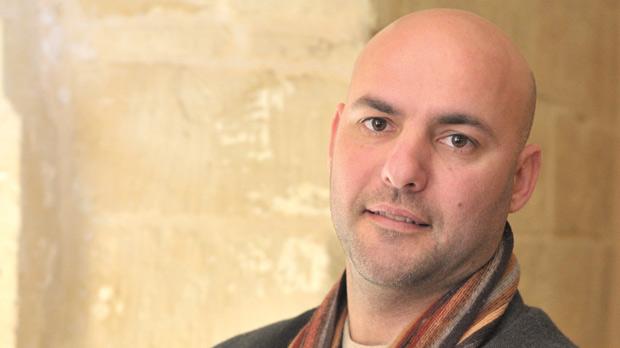
Pierre Ellul has worked in film and television for over 12 years. In TV he has worked both for Maltese and foreign channels including a Swedish satellite channel, the BBC, DW-tv (Germany) and ZDF.
His career in film has seen him work alongside Ridley Scott (on the films Gladiator, Hannibal, Black Hawk Down and Kingdom of Heaven), Alfonso Cuaron (Children of Men), Wolfgang Petersen (Troy) and Steven Spielberg (Munich – for which he received a Director’s Guild of America award nomination), among others.
Dear Dom, which opens exclusively at the Eden Century Cinemas on Friday, is Ellul’s first feature-length project.