‘God help us’
Residents of Homs described scenes of panic and carnage in the city of central Syria undergoing a fierce assault by government troops, urging outside powers to intervene to halt the bloodshed. “What is happening is indescribable,” said Wael, a...
Residents of Homs described scenes of panic and carnage in the city of central Syria undergoing a fierce assault by government troops, urging outside powers to intervene to halt the bloodshed.
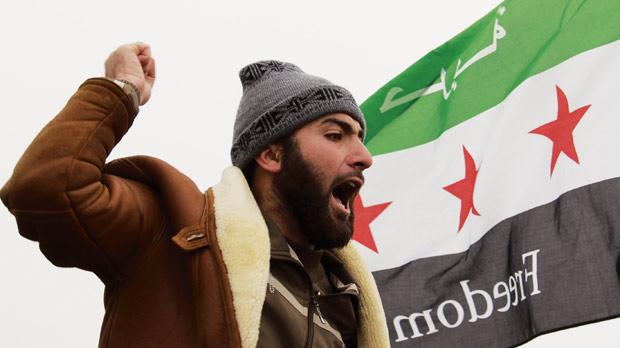
Assad thinks he is going to scare people but they are going to rise up more and are more determined than ever
“What is happening is indescribable,” said Wael, a resident reached by telephone. “Security forces have been relentlessly shelling the city since this morning.
“On the streets, there are only bodies and wounded people along with tanks,” he said. “There are tanks everywhere.
“People are in a state of panic and they are screaming, ‘May God help us’ or ‘Where are the Arabs’?” he added. “We feel like the world has abandoned us.”
Activists said the latest government assault on the city began at dawn with troops raining mortars and rockets on several neighbourhoods.
“We cannot venture outside because of the intensity of the shelling,” said Saher, another resident. “The shells are coming down like rain.”
The shelling was mainly targeting the neighbourhoods of Khaldiyeh, Baba Amro, Inshaat and Bab Sbaa, the Britain-based group said.
Syrian state television accused “armed gangs” of being behind the latest violence in Homs, which has become a flashpoint of the near 11-month revolt that has killed at least 6,000 people across the country according to rights groups.
A resident of the battered said that the assault was the most intense since the outbreak of the unrest in mid-March.
“What is happening is horrible, it’s beyond belief,” said Omar Shaker, an activist also reached by telephone. The sound of gunfire and loud explosions could be heard in the background as he spoke.
Mr Shaker said activists were transporting the wounded to the city’s mosques for treatment.
“There is nowhere to take shelter, nowhere to hide,” he said. “We are running short on medical supplies and we are only able to provide basic treatment to the injured.”
Residents said hospitals had also run out of blood supplies.
Footage shot by a BBC undercover team in Homs showed buildings ablaze in rebel neighbourhoods as regime forces pounded them with heavy weapons.
Plumes of white smoke billowed into the sky. Chants of “Allahu Akbar” (God is Greatest) could be heard from balconies and rooftops as residents put on a show of defiance in the face of the onslaught.
A video posted by activists on YouTube apparently showed a field hospital hit by the shelling in Baba Amro, one of the main targets of the assault.
Wounded patients could be seen laying on stretchers on the floor amid pools of blood and shattered glass. Bodies of dead people with horrific injuries were also shown inside the hospital. The authenticity of the video could not immediately be verified.
“Let the Arabs and Muslims come and see this, this is a result of their inaction,” said Mohamed Mohamed, who identified himself as a doctor at the hospital. Wael said some residents were scared of leaving the city while others, especially those with children, were braving sniper fire and fleeing.
“We want the international community... to get rid of (President Bashar) al-Assad,” he said.
“Assad thinks he is going to scare people but they are going to rise up more and are more determined than ever.”
Diplomatic moves against Syria
Here are the main sanctions and other diplomatic measures against the regime of Syrian President Bashar al-Assad, in protest at the deadly crackdown on an uprising which started last March.
Activists say more than 6,000 have been killed since the start of the uprising on March 15, 2011.
April
• 29: US imposes restrictions on financial transactions and freezes assets, notably targeting Maher al-Assad, the powerful brother of the President who commands Syria’s feared Fourth Armoured Division.
May
• 10: The European Union enforces sanctions on a list of 13 senior officials, including Maher al-Assad, and imposes an embargo on arms.
• 18: The United States slaps Mr Assad and six other regime leaders with sanctions.
• 24: The EU imposes an assets freeze and travel ban on Assad.
August
• 3: The UN Security Council condemns the crackdown.
• 7: Saudi Arabia recalls its ambassador from Damascus, followed by Kuwait and Bahrain. Qatar recalled its ambassador in mid-July.
• 10: The US imposes sanctions on Syria’s largest state-run commercial bank.
• 18: US President Barack Obama and his Western allies call on Mr Assad to resign. The US freezes all Syrian government assets and bans investment and exports to the country and imports of oil and gas.
September
• 24: The EU bans new investments in the oil sector and prohibits the delivery of banknotes to Syria’s central bank.
October
• 1: Switzerland tightens its sanctions, including banning investment in Syria’s oil sector.
• 4: Russia and China veto a UN Security Council resolution condemning Syria.
November
• 12: The Arab League decides to suspend Syria.
• 27: Arab foreign ministers agree on sweeping sanctions against Damascus, including an immediate ban on transactions with the Syrian government and central bank, and a freeze on Syrian government assets in Arab countries.
• 30: Turkey imposes an immediate ban on transactions with the Syrian government and central bank, and a freeze on Syrian government assets. New sanctions in December.
December
• 1: Kuwait follows Bahrain, Qatar and Saudi Arabia in calling on its nationals to leave Syria.
• 2: The UN Human Rights Council urges tougher international action against Syria, condemning “gross violations”.
• 6: The French ambassador returns to Damascus after being recalled to Paris in mid-November.
• 9: Switzerland toughens its sanctions.
January 2012
• 22: Arab League foreign ministers urge Assad to transfer power to the vice president. The Syrian regime rejects the plan.
• 23: The EU adopts fresh sanctions against Syria’s military brass, targeting a large number of security officials on a new list of people and firms hit by a travel ban and asset freeze.
• 25: Canada agrees a fifth round of sanctions.
• 28: The Arab League suspends its observer mission in Syria, sent in late December, a day after the monitors’ chief said killing had spiked.
February
• 4: Russia and China veto a UN Security Council resolution condemning the Syrian government’s crackdown, prompting indignation in the Arab world,in the West and in the Syrian opposition.
• 5: Tunisia’s Prime Minister calls on all countries to expel Syrian ambassadors.
• 6: The United States closes its embassy in Syria and pulls out all its staff. Britain recalls its envoy for consultations.