World Briefs
Hopkins to release album
Hollywood star Sir Anthony Hopkins is adding a new string to his bow by releasing his first collection of classical works. The Welsh star has long worked on his own compositions and has previously scored the music to some of his films. Now he is to release a CD of his music, some of which dates back to jottings from childhood.
The star – who won an Oscar for his performance as serial killer Hannibal Lecter – joined the City of Birmingham Symphony Orchestra (CBSO) on stage in the summer to introduce a concert of his tunes.
Now the recording of the performance – at Birmingham Symphony Hall – will be released by radio station Classic FM. The album features nine compositions, including music from his films August and Slipstream, which he scored.
Sir Anthony was a promising pianist as a child, taking lessons from the age of six, and recording his thoughts on manuscripts. He learned about orchestration from one of his father’s encyclopaedias as a child. Violinist Andre Rieu recorded his tune And The Waltz Goes On earlier this year, the title track of his most recent album. The album comes out on January 16.
Science solves illusion
Scientists have discovered why buttercups glow yellow under people’s chins – and it has nothing to do with liking butter.
Researchers found that the flower’s unique anatomical structure, used to attract pollinating insects, contributes to the illusion. Experts in physics and plant scientists from Cambridge University worked on the problem that has perplexed generations of researchers.
They discovered that the buttercup petal’s bright and glossy appearance is the result of interplay between its different layers. The yellow reflection responsible for the chin illumination is mainly due to the epidermal layer of the petal that reflects yellow light with an intensity that is comparable to glass.
Viking silver ‘lucky find’
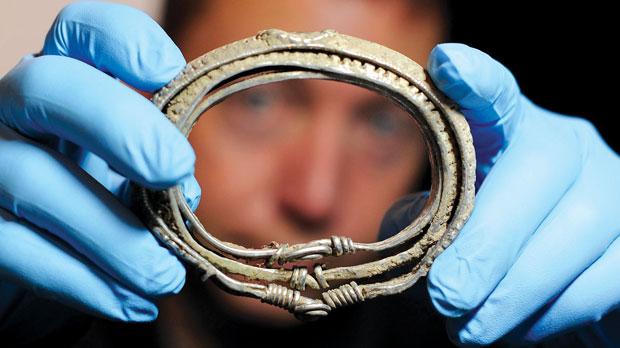
A man who found a hoard of Viking silver that had lain undetected for hundreds of years has described his discovery as “lucky”.
Darren Webster got his metal detector out in a field near his home when he had an hour to spare one day, and 20 minutes later was digging up a hoard of hidden silver coins and jewellery.
The 39-year-old stone mason from Lancashire made the discovery in September on land around Silverdale in north Lancashire.
He said: “The coins, the bracelets, I knew it was possibly Viking, more than likely Viking.”
Mr Webster found the hoard buried in a lead pot about 16 inches underground.
Experts believe the hoard, which includes 27 coins, 10 arm rings, two finger rings, 14 ingots, six brooch fragments and a fine wire braid which may have been worn as a necklace, could have been buried by a Viking warrior before he went into battle.
It dates from a time when the Anglo-Saxons were trying to take control of the north of the country from the Vikings and includes a coin that is thought to refer to a previously unknown Viking ruler in northern England.